
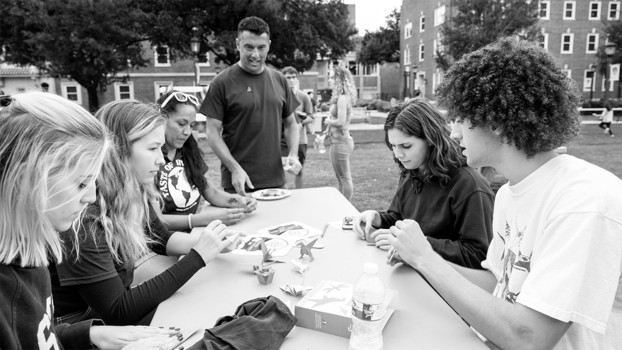
The purpose of this study is to examine the cognitive and emotional labor performed by faculty-in-residence (FIR) as they navigate the blurred boundaries between their academic roles and their live-in responsibilities within on-campus residential communities. Because faculty-in-residence occupy a position that merges instruction, mentorship, crisis response, and community-building within the very spaces where they also live and rest, they may carry substantial forms of invisible labor that are rarely captured in workload models, position descriptions, or institutional reward structures.
Using a qualitative, phenomenological design, this study will draw on semi-structured interviews to understand how faculty-in-residence perceive, perform, and set boundaries around the affective and cognitive demands of the role—including the work of being perpetually “on,” managing student expectations, and preserving personal and family space. We will also attend to how institutional structures, compensation, training, and support (or their absence) shape these experiences, with particular attention to how this labor is distributed inequitably across gender, rank, race, and caregiving status. Findings are intended to inform more sustainable role design, equitable support structures, and institutional policy for live-in faculty programs.
Collaborators:

